Internet scams are often pictured as a lone fraudster with a laptop. In practice, the larger operations resemble legitimate businesses, with specialised roles, referral relationships, fee-for-service arrangements and layers of separation between the people who do the work and the people who hold the money. Understanding that structure is the first step to disrupting it.
The structure: a bottom-heavy pyramid
Like legitimate businesses, the scam economy is bottom-heavy. At the base, the work is the least demanding and carries the most risk, and many people slug it out for scraps that, by their own country’s standards, amount to respectable pay. Each tier above is smaller, more specialised and harder to reach.
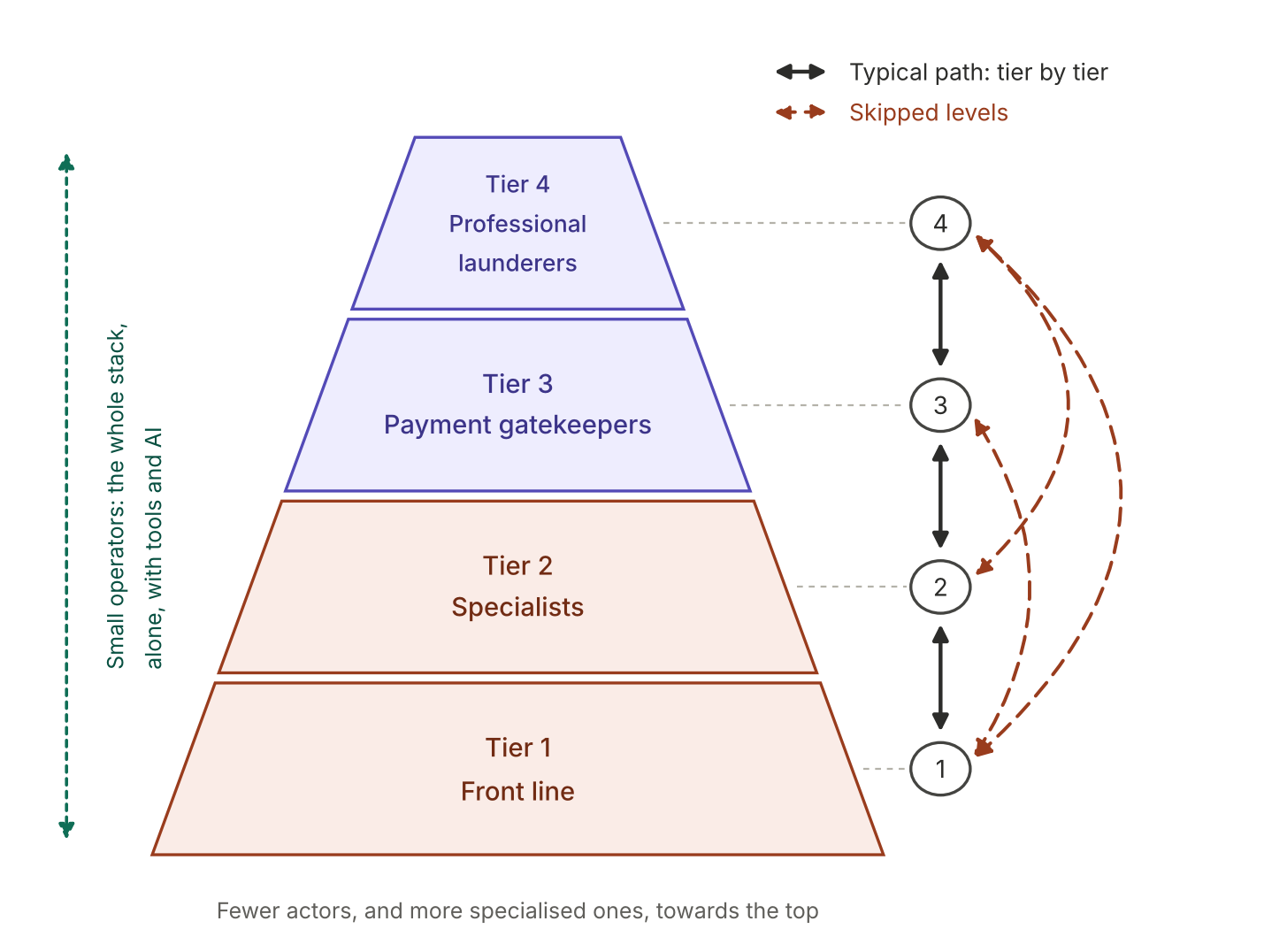
Tier 1: The front line
This is the crowded end of the ecosystem. These are the people in direct contact with victims, and they scale by increasing victim count rather than sophistication. They usually rely on a single layer of protection: account layering. This means keeping separate accounts and channels of communication for each stage of the scam:
- Trust: building rapport and credibility with the victim.
- Transfer: moving the money.
- Disconnect: cutting contact.
Tier 2: The specialists
This tier is smaller and a little more sophisticated. It helps make the materials that earn the victim’s trust, such as legitimate-looking documents and other artefacts. Some specialists also help with advanced transaction layering using money mules.
Tier 3: The payment gatekeepers
These people process payments for the scammers who depend on them and centralise the payment stage for their circle. They use channels such as money transfer services and remittance apps (MoneyGram and Lemfi, for example) and gift cards, including Apple cards. The process is less straightforward than it is usually portrayed, because gatekeepers vary in sophistication. The more advanced ones charge higher percentages because they are perceived as foolproof, and that reputation rests on how well they cover their tracks.
Tier 4: The professional launderers
At the top are specialists who mask the source of wealth through fronts such as influencer marketing or real estate development. By the time money reaches this tier, it is several steps removed from any victim.
How the tiers line up with the research
The published literature supports the broad shape of this model, although most of it was written about specific parts of the ecosystem rather than the whole.
| Tier | What the published research says | Source |
|---|---|---|
| 1. Front line | Fraud is organised by specialisation and run through informal networks. Fraudsters ask small sums from many people to widen the pool. | Tade & Aliyu (2011) |
| 2. Specialists | Professional laundering networks recruit and manage money mules and open accounts. Document and image production is not covered in the sources reviewed. | FATF (2018) |
| 3. Gatekeepers | Insiders at banks can leak customer details and help payments go through. Gift cards and similar methods are common payment requests in romance scams. | Tade & Aliyu (2011); Federal Reserve payments handout |
| 4. Launderers | Launderers work for a fee or commission, use front companies and buy real estate. Laundering is increasingly sold as a service. | FATF (2018, 2026) |
Movement between the tiers
The typical pattern follows the pyramid: work moves tier by tier, and each tier adds a layer of separation. In practice, levels can be skipped. Seasoned criminals usually keep to the structure, because every tier they pass through adds protection, while less experienced operators skip levels and accept the exposure. Movement also runs both ways. Money moves up the pyramid, while instructions, materials and recruits move down it, which is why Figure 1 uses two-way arrows.
Compartmentalisation, and the small operator
Many smaller players do not know how far the ecosystem extends. They know only the niche they occupy, whether that is chatting with victims, producing documents or moving funds. This compartmentalisation protects the structure, since no single participant at the bottom can describe the whole. Each tier also has many variants, so the model is a simplification and not a rigid blueprint.
The same ecosystem also allows the opposite. Smaller scammers can run the whole system themselves with the right tools. Services now exist that convert gift cards into cash, which removes the need for a human gatekeeper in smaller scams. AI has done something similar for the specialist tier: a scammer no longer needs a Photoshop expert to edit pictures or prepare documents, because AI can do much of that work. For the small operator, the pyramid collapses into one person.
This ties into proportionality. Sophistication scales with the amount of money involved. For smaller scams, advanced source layering is unnecessary, and primary layering, such as collecting payment through gift cards, is usually enough. The sums are too small to attract serious scrutiny, and the cost of the upper tiers would eat into the proceeds. Tiers 3 and 4 come into play as the stakes rise, because only at larger sums are the fees charged by advanced gatekeepers and launderers worth paying.
The recursive scam
Disconnect is rarely the first exit. Many scams run in loops, with the same victim milked repeatedly. The break comes either when the victim realises what is happening and walks away, or when the scammer sees there is nothing left to take. Which side disconnects depends on the type of scam. Researchers describe this pattern as re-victimisation (Whitty, 2013), and a US payments-industry handout describes it as retargeting. Here it is called the recursive scam.
A victim who is drained is not recruited as a mule. A mule is only useful with a working account, access to funds and enough trust to follow instructions, and a victim with nothing left typically disconnects. A victim who is still useful but no longer a good source of money may instead be converted into a mule, which feeds the layer above. This ties the front line to the specialist tier.
Why this matters
- Why it persists. Compartmentalisation means that arresting front-line operators rarely reaches the people above them, and the economic pull at the base keeps replenishing the workforce.
- Where the leverage is. The payment and laundering tiers are the narrow points in the pyramid. They are fewer in number and more dependent on the formal financial system, which makes them the most important points for banks, fintechs and compliance teams to monitor.
- Small scams versus larger ones. Low-value scams rely on simple, primary channels, so they may leave more recognisable patterns for payment providers and retailers to catch. Larger operations require monitoring further up the chain.
- The takeaway. Scams are best tackled as supply chains, not as isolated crimes. As AI and cash-out tools let a single person do the work of several tiers, monitoring has to follow the money and the tools as well as the people.
Limits of this analysis
- The pyramid is an analytical model. Research on related fraud types describes structures that are often fluid, with adaptive roles, and not a fixed chain of command.
- The Nigeria-specific fieldwork is small and dated, and FATF’s work covers laundering generally and not scams specifically.
- The claims about tier skipping, gatekeeper pricing, the small-scam proportionality point, gift-card conversion tools and AI replacing specialists come from the author’s own observation. They fit the research but need sourcing before publication.
References
- Federal Reserve payments improvement site. Romance impostor scam (handout). fedpaymentsimprovement.org/wp-content/uploads/romance-impostor-scam.pdf
- FATF (2018). Professional Money Laundering. Financial Action Task Force.
- FATF (2026). Report on underground banking, hawala and professional money launderers. fatf-gafi.org/en/news/pml-underground-banking-hawala-hossps-2026.html
- Tade, O. & Aliyu, I. (2011). Social organization of internet fraud among university undergraduates in Nigeria. International Journal of Cyber Criminology, 5(2).
- Whitty, M. T. (2013). The scammers persuasive techniques model: Development of a stage model to explain the online dating romance scam. British Journal of Criminology.
- Study of business email compromise fraud structure (2024). doi.org/10.1080/01639625.2024.2352049
This is an analytical model for defensive understanding, not a how-to. Similar framing underpins the site’s Fraud Pattern Framework and context comparisons.